Prime Day stopped being an Amazon event a while ago. Last July it pulled more US online spend in 4 days than Black Friday and Cyber Monday combined, and almost nobody selling online had a normal week. Marketplace sellers watched Amazon revenue spike, brands with their own stores watched traffic and sales move in both directions at once, and the meetings that followed were the same across retail: was the event a win, or did it just move revenue around? Most of those arguments went nowhere, because nobody had written down what a normal week was supposed to look like before the event started.
If that argument sounds familiar, you have less time to avoid it this year. Amazon moved Prime Day 2026 up to June 23 to 26, the first June event since 2021 and 4 days long again. That is 2 weeks from now. The math that settles the argument takes an afternoon to set up, and nearly all of it has to happen before the event starts. This is the Prime Day halo effect math: the 3 numbers to lock this week, what to watch while the event runs, and the readout that tells you whether Prime Day grew your business or just moved it.
Key takeaways
- Prime Day 2026 runs June 23 to 26, roughly 2 weeks earlier than the usual July slot. Whatever baseline work you planned for early July is now due this week.
- The surge is market-wide. US retailers did $24.1B in online sales during Prime Day 2025, and brands running parallel promotions saw an average uplift above 53% in top categories.
- A blended dashboard cannot tell incremental revenue from shifted revenue. Only a pre-event baseline can, and a baseline you compute after the event is a story, not a baseline.
- Lock 3 numbers before June 23: a baseline forecast for your own store, your halo window, and your promo depth against contribution margin.
- The post-event readout has 4 steps: total lift vs baseline, the pull-forward check, the returns adjustment, and the margin pass.
Prime Day moved to June, and your measurement plan moved with it
The event keeps getting bigger and less Amazon shaped. Adobe tracked $24.1B in US online spend across retailers over the 4 days of Prime Day 2025, up 30.3% on the year before. The first 24 hours alone did $7.9B. Almost every retailer with a pulse now runs something that week, and Similarweb's event coverage showed Walmart's online growth outpacing Amazon's during the 2025 window.
The June date matters more than it looks. Brands plan inventory, promo calendars, and reporting around a mid-July event, and the earlier date has already compressed supply chains. It compresses measurement the same way. The clean pre-event weeks you would normally use to establish a baseline are the 2 weeks you are in right now.
The halo is real, which is exactly why your dashboard will lie to you
Money moves in 3 directions during the event, and your dashboard adds them into 1 number.
First, your own ads drive Amazon conversions you never see. A shopper who sees your TikTok or Meta ad in the run-up has a Prime membership and a saved card waiting 2 clicks away, and during the event plenty of them buy there instead of on your site. Site-only ROAS counts that spend but not those sales, so the channels doing the discovery work look weakest in exactly the week they work hardest. If you sell on Amazon, read that week's ad performance with the marketplace number next to it before judging any channel.
Second, the surge lifts your own store too, if you give it somewhere to land. 10 years of Visualsoft retailer data shows retailers that align their own offers with the event see consistent category uplifts, averaging 53.8% across top categories in 2025, and Numerator's shopper tracking found 49% of Prime Day shoppers had shopped or planned to shop Walmart's overlapping sale. The week is a spending moment, not a platform, which is why brands like Brooklinen and Casper treat it as a mid-year Black Friday rather than ceding it.
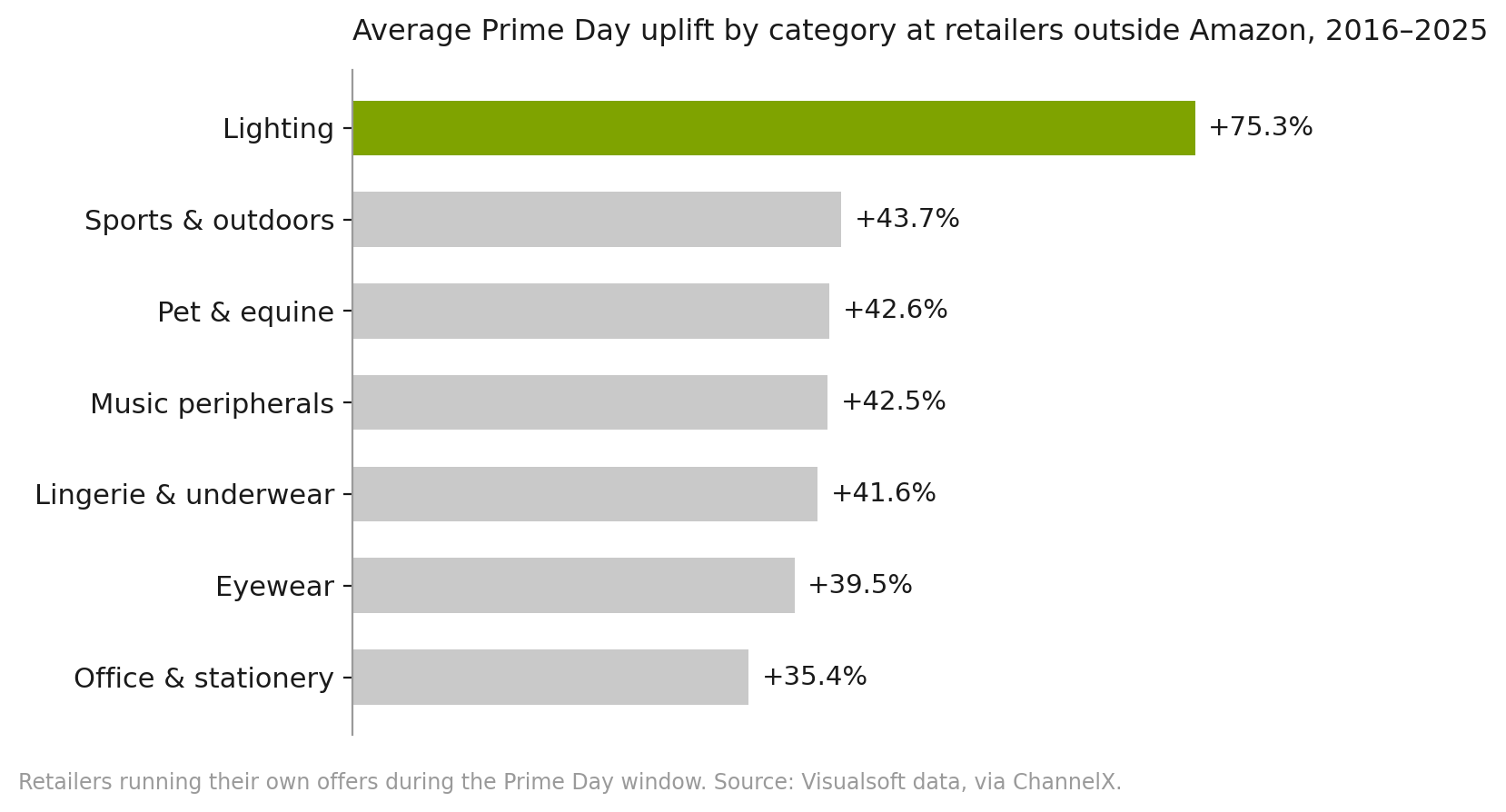
The halo across a decade: average Prime Day uplift in top categories at retailers running their own offers. Source: Visualsoft data via ChannelX.
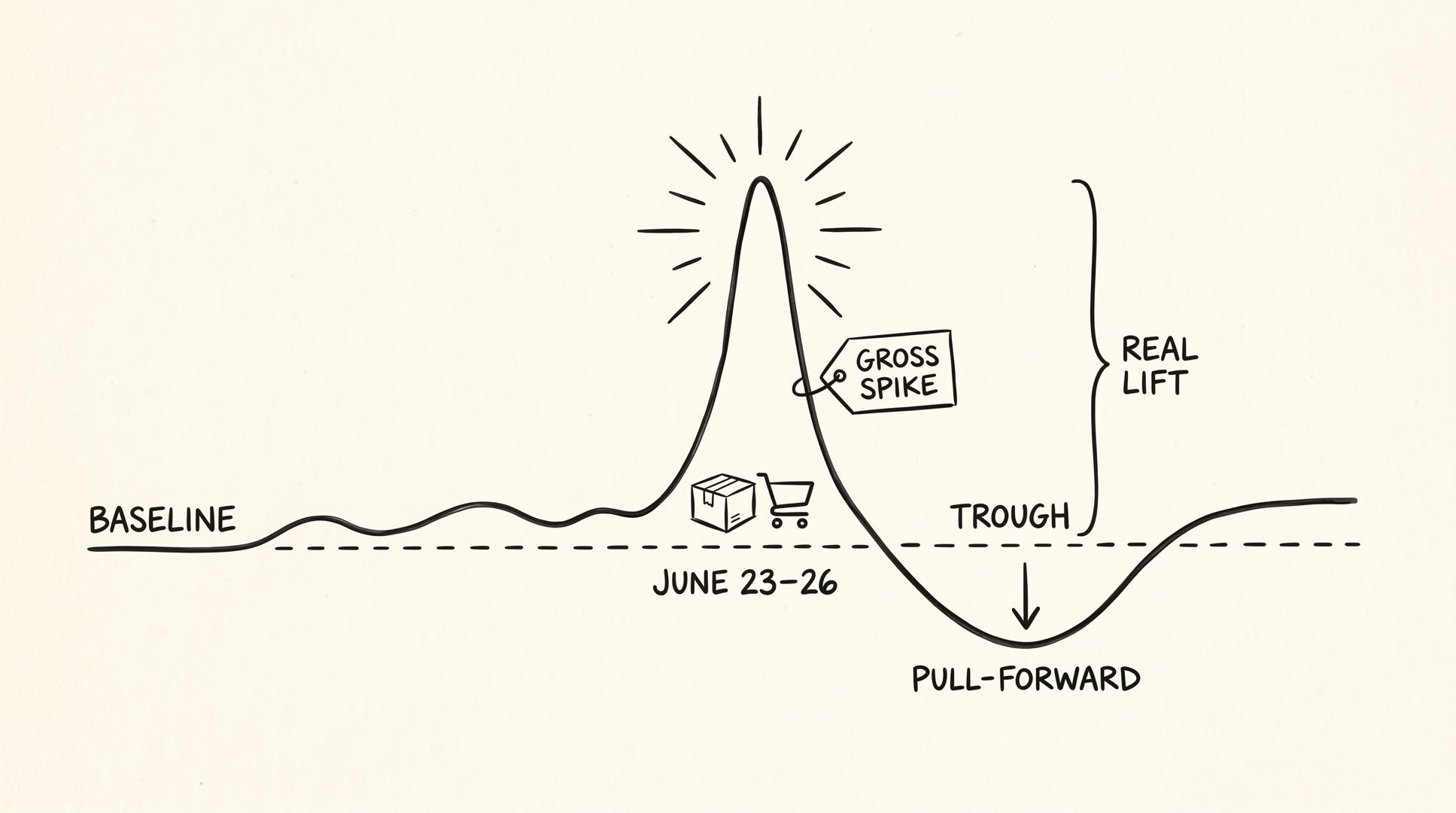
Third, some of your spike is your own demand pulled forward. The customer who bought on June 24 at 25% off may be the same customer who would have paid full price on July 8. That sale shows up as event revenue and costs you margin twice, once in the discount and once in the July order that never comes.
Each of these is invisible in a blended ROAS number. Which is why the work happens before the event.
Before June 23: the 3 numbers to lock this week
| Number | The question it answers | How to build it |
|---|---|---|
| Owned store baseline forecast | What would these 3 weeks have looked like without Prime Day? | Trailing 8 weeks of daily revenue from your own channels, promo days stripped out, projected across June 16 to July 5 |
| Halo window | Which days count as “the event” for us? | Pick the full window now (June 20 to 28 catches the spillover) and commit to it in writing |
| Promo depth vs margin | At our discount, how much more do we need to sell to break even? | Contribution margin per order at promo depth, including fees and shipping, converted to a breakeven unit lift |
The baseline forecast is the one nobody does and the one that settles every argument later. It does not need a data team: trailing 8 weeks of daily revenue, take out the days you ran promos, project forward with a simple weekly seasonality pattern. Write the number down per day. The whole point is that it exists before the event does.
One wrinkle specific to 2026: Father's Day lands on June 21, 2 days before the event starts. If you sell anything gift shaped, your trailing weeks already contain a demand bump that has nothing to do with Prime Day, and a baseline that does not account for it will overstate the event's lift. Strip the gifting bump out the same way you strip promo days, or note it in the readout as a known distortion.
The halo window matters because the fight in August is usually a definition fight. If marketing measures June 23 to 26 and finance measures the full month, both sides are right and the meeting goes nowhere. Agree now on the window, including 2 to 3 days either side for spillover, and agree that the pull-forward check extends 2 to 3 weeks past it.
The margin math is the one that changes decisions mid-event. If you run 25% off and your contribution margin is 30% at full price, you need roughly 4x the unit volume to make the same dollars. Most operators sense this and almost none compute it in advance, which is how a record revenue week becomes a flat margin week that gets celebrated anyway.
During the event: watch 3 things, ignore 1
Watch your site sessions and branded search against the baseline, because that is the halo arriving in real time and it tells you whether the event is feeding your site or starving it. Watch new to brand share on Amazon, since new customers are the strongest evidence of real incrementality. Watch sell through pace against inventory, because a stockout on day 2 caps the whole experiment.
Ignore daily blended ROAS. Attribution gets worse during events, not better. Platforms over-credit the surge, conversion windows smear event purchases across the following week, and the discount sits in none of the platform math. Mid-event budget decisions made off a platform dashboard during Prime Day are about as informed as they would be on Black Friday morning, and operators know better than to make them then.
The same caution applies to your email channel. Klaviyo will credit its usual share of a surge week, and a surge week is exactly when last-touch crediting inflates the most, since every customer the event sent to your site clicked something on the way in. If email's reported revenue triples during the window, treat that as a measurement artifact to investigate in the readout, not a result to act on Tuesday.
After: the readout that separates incremental from shifted
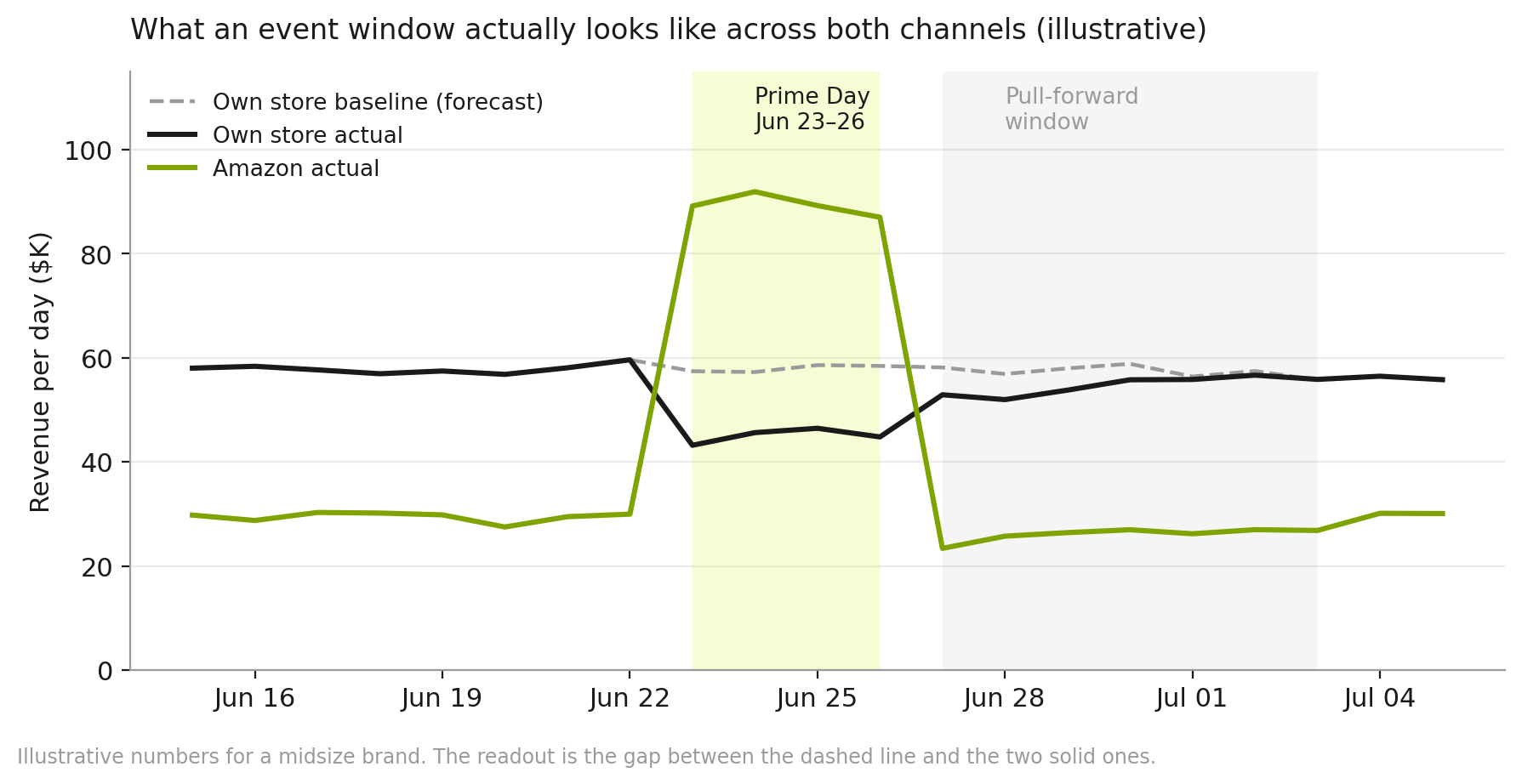
The shape to look for: the spike, the dip, and the trough that follows. Illustrative numbers for a midsize brand.
The readout is 4 steps, run in order.
Step 1: total lift. Add both channels across your halo window and compare against the baseline forecast for the same days. The gap is your gross lift, and it is the only number most teams ever compute.
Step 2: the pull-forward check. Compare the 2 to 3 weeks after the event against baseline. The trough below baseline is demand you borrowed from July, and it comes straight off the gross lift. In the chart above, the brand's lift looks great until you notice the store's line running under the dashed line into early July.
Step 3: the returns adjustment. Event purchases return at higher rates than full-price purchases, and the return window for a June 23 order closes well into July. Put the final readout date on the calendar now, 30 days after the window closes, and label anything you report before then as preliminary.
Step 4: the margin pass. Convert the surviving lift into contribution dollars at the promo depth you actually ran. This is the step that turns “Amazon tripled” into a sentence a CFO can use.
What survives all 4 steps is your incremental number. It is smaller than the dashboard number, it is defensible in any meeting, and a brand that runs this readout once has a baseline discipline it gets to reuse every event after. One honesty note: single-brand math without a holdout is directional, not proof. Say so in the readout. A directional number everyone trusts beats a precise number nobody does.
The version that fits on one page
| When | Do this |
|---|---|
| By June 19 | Baseline forecast written down per day, halo window agreed, breakeven unit lift computed at your promo depth |
| June 23 to 26 | Watch site sessions, branded search, new to brand share, and inventory pace. No budget moves off blended ROAS |
| June 27 to July 17 | Track the pull-forward trough against baseline |
| Late July | Run the 4-step readout, returns included, in contribution dollars |
If the baseline step is where this falls apart for you, that usually means the underlying numbers disagree before the event even starts. That is the work we do at Hologrow: one transparent view of your marketing and commerce data, with every number traced back to its source. Contact us for a demo and we will help you get to a baseline you can defend before June 23.
FAQs
When is Prime Day 2026?
June 23 to 26, 2026, a 4 day event starting at 12:01am PDT on June 23. It is the first June Prime Day since 2021; the event ran in July for the 4 years between.
Does Prime Day cannibalize your other sales channels?
Sometimes, and the only way to know for your brand is a pre-event baseline. Many sellers see their own store dip during the event window while Amazon spikes, then recover. The honest answer comes from comparing both channels combined against a forecast of what the period would have done anyway, then subtracting the pull-forward trough that follows.
Should my brand run a competing sale during Prime Day if we are not on Amazon?
The traffic surge is market wide, not Amazon only. US retailers did $24.1B during the 2025 event, and brands running parallel promotions saw average uplifts above 53% in top categories. The deciding number is your contribution margin at the discount you would run, not the traffic.
What is the Prime Day halo effect?
The lift that spills beyond Amazon during the event: more traffic and sales for retailers generally, and ad spend driving Amazon conversions that store-only measurement misses. Retailers that aligned their own offers with Prime Day 2025 saw top-category uplifts averaging 53.8%, and 49% of Prime Day shoppers also shopped or planned to shop Walmart's overlapping sale.
How long does the pull-forward effect last after Prime Day?
Typically 2 to 3 weeks of below baseline demand, longer for considered purchases. That is why the readout window should extend into mid-July this year, and why a readout run the Monday after the event always overstates the win.
How do I measure Prime Day incrementality without a data team?
A spreadsheet version gets you most of the way: trailing 8 week baseline projected across the event period, both channels totaled against it, the post-event trough subtracted, and the result converted to contribution dollars. It is not a geo holdout, so treat it as directional and label it that way.