
Loyalty has evolved from a simple game of handing out points to becoming a sophisticated, strategic revenue lever. But when the board asks, "Is a loyalty program worth it?", the answer shouldn't be a shrug and a mention of "brand vibes." The true value of a program depends entirely on your ability to measure impact beyond simple enrollments or discount redemptions. To prove worth, you must focus on incremental revenue, retention lift, Customer Lifetime Value (CLV), and operational efficiency.
Top-tier brands and industry analysts now evaluate success through rigorous loyalty program metrics and deep loyalty analytics, rather than relying on vanity statistics. This guide explains exactly how modern brands move past the "points-issued" ledger and turn their loyalty initiatives into a measurable, high-return growth engine.
Why Measuring Loyalty Program ROI Matters
Loyalty Investment Is a Strategic Business Decision
In 2026, viewing loyalty as a "marketing expense" is an outdated mindset. According to Bain & Company, customer retention is the ultimate driver of profitability—boosting your retention rate by just 5% can increase profits by 25% to 95%. This is because loyal customers tend to spend more per transaction and churn significantly less. Therefore, a loyalty program must be evaluated as a high-stakes growth investment, requiring the same financial scrutiny as any other capital expenditure.
Traditional Metrics Miss the Bigger Picture
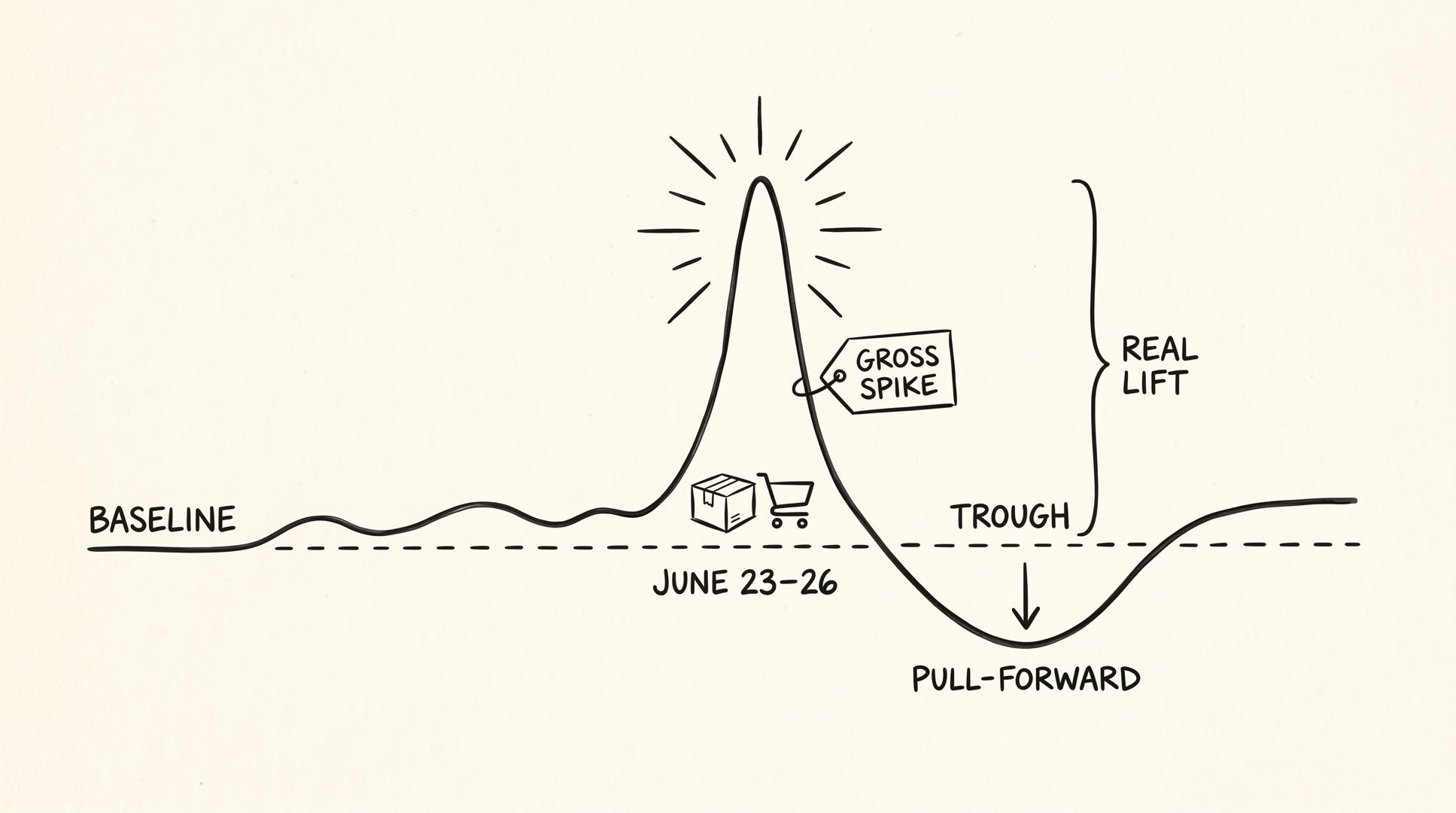
Counting members or the total number of points issued is a feel-good exercise, but it isn't the same as measuring actual value delivered. Gartner emphasizes that brands must move toward business KPIs that are directly tied to financial impact. If you cannot differentiate between a customer who would have bought from you anyway and one who bought because of the program, your loyalty program ROI is essentially a work of fiction.
Core Loyalty Program Metrics That Indicate True ROI
Effective measurement requires a balanced diet of behavioral and financial data. To see the full picture, brands must track these five critical categories.
Retention Lift (Repeat Purchase Rate)
The repeat purchase rate measures how often loyalty members return compared to non-members. A significant lift here is the strongest signal that your program is actually changing behavior rather than just accumulating digital dust. To calculate the true impact, use this formula:
Incremental Revenue Per Member
This metric is the "Holy Grail" of loyalty analytics. It isolates the revenue that is truly incremental to the loyalty program, effectively separating organic repeat behavior from program-driven influence. By stripping away the "would-have-purchased-anyway" segment, you get a clear view of your program’s true power.
Customer Lifetime Value (CLV) Increase
Research from BCG consistently shows that personalized loyalty programs drive higher lifetime value. By fostering emotional engagement and more frequent interactions, you extend the duration and value of the customer relationship. A positive change in CLV is the ultimate indicator of long-term health beyond short-term "earn and burn" discount spikes.
Engagement Metrics (Loyalty Analytics Signals)
These signals are the leading indicators of future revenue. While they aren't the ROI themselves, they correlate strongly with success when analyzed properly. Key signals include join conversion rates (views to enrollments), average points earned per member, and reward redemption rates. High engagement across these areas usually translates to a stronger revenue lift.
Core Web Vitals & Experience KPIs
Performance matters more than most marketers realize. A poorly implemented loyalty widget that drags down your Core Web Vitals (like LCP, CLS, or FID) can reduce your overall site conversion rate, effectively wiping out any gains made by the loyalty program. You must monitor technical experience KPIs alongside business KPIs to ensure your tech stack isn't self-sabotaging your ROI.
Loyalty Analytics Frameworks That Reveal ROI
Modern loyalty analytics go beyond a single dashboard; they integrate multiple data sources to connect human behavior with business outcomes.
Cohort-Based Analytics
Cohort analysis allows you to track specific groups of members over time. This helps you visualize repeat visit patterns, spend trajectories, and engagement decay. By comparing the 2025 signup cohort to the 2026 cohort, you can determine if your program improvements are actually yielding better long-term behavior.
Controlled Holdout Experiments
This is the gold standard for attribution. By randomizing who receives loyalty offers versus a "control group" that does not, you can measure the exact difference in behavior. This removes the "noise" of general market trends and isolates the effect of the loyalty program itself—proving incrementality beyond a shadow of a doubt.
How Hologrow Helps Measure ROI with AI-Powered Intent Recognition
Hologrow.AI leverages advanced, AI-driven intent recognition to provide a real-time, dynamic system that continuously tracks customer behavior and adapts loyalty incentives to maximize your loyalty program ROI. Instead of relying on static rules or broad, manual segments, Hologrow uses AI to personalize rewards based on real-time user intent. This ensures that you aren't wasting margins on customers who were already going to buy, but instead incentivizing those at the critical point of decision.
By adopting Hologrow, brands can achieve:
- Accurate ROI Tracking: We integrate with your existing marketing stack and CDPs to link loyalty actions directly to incremental revenue.
- Predictive Financial Modeling: Our AI engine identifies high-value segments and offers incentives based on browsing behavior, ensuring every reward has maximum impact.
- Real-Time Data Clarity: Our easy-to-read dashboards update in real-time, showing you exactly where your retention rates, CLV, and revenue are moving. Hologrow eliminates the operational burden of manual configuration, allowing your team to focus on strategy while the AI optimizes for ROI.
Calculating Loyalty Program ROI — A Practical Model
If you’re ready to run the numbers, use this simplified four-step model to estimate your program’s worth:
- Step 1: Define Baseline — Determine your current repeat purchase rate and average purchase value for non-members.
- Step 2: Measure Uplift — Multiply your membership size by the lift in repeat purchase frequency.
- Step 3: Multiply by Contribution Margin — Calculate the incremental revenue and multiply it by your gross margin.
- Step 4: Subtract Costs — Deduct the platform fees, reward costs (the liability of points), and operational overhead. Stop the Guesswork: If the math above seems daunting, we’ve done the heavy lifting for you. Use the Hologrow ROI Calculator to get a customized projection of your potential revenue lift in under 2 minutes.
Tools & Platforms That Help Measure Loyalty ROI
A loyalty program’s value is magnified when it is plugged into a robust data infrastructure. To truly master your loyalty analytics, your stack should include:
- CDP (Customer Data Platform): To unify member attributes across all channels.
- BI (Business Intelligence) Tools: For creating custom correlation and attribution dashboards.
- Experimentation Platforms: For running the necessary holdout tests to prove incrementality. A high-quality SaaS loyalty platform will offer easy event-level data exports to these tools, ensuring your data isn't trapped in a silo.
Vendor Evaluation Checklist — Focused on ROI & Analytics
Use this table to score potential vendors on their ability to help you prove and grow your ROI:
Conclusion — Loyalty Is Worth It When Measured Strategically
A loyalty program’s worth is not defined by the sheer volume of points issued; it is defined by the measurable change in customer behavior that leads to more visits, larger baskets, and higher lifetime revenue. By adopting robust loyalty program metrics and a data-driven approach to loyalty analytics, you can transform a simple "points scheme" into a powerful, predictable growth engine.
Don't Waste Time on Spreadsheets: Let AI Generate Your ROI
Are you tired of staring at complex formulas and trying to guess your incremental lift? You don't have to be a data scientist to run a world-class loyalty program. With the Hologrow AI Loyalty Program Generator, you can skip the manual math entirely.
Our intelligent AI Agent does the heavy lifting for you:
- Automatic ROI Calculation: It pulls your real-time data to calculate exact ROI and incrementality.
- Visual Data Reporting: Get clear, beautiful dashboards that show your LTV growth and retention lift at a glance.
- Zero-Friction Setup: Simply tell the agent your budget and goals, and it will design and execute the high-ROI strategy for you. Stop guessing and start growing. Book a demo and launch your AI Loyalty Pilot with Hologrow today** and let our agent handle the ROI for you.**
FAQs about Loyalty Program ROI
What is ROI for a loyalty program?
Loyalty program ROI is the net financial benefit (incremental revenue minus the costs of rewards and operations) divided by the total cost of the program. It essentially measures how many dollars of profit you generate for every dollar spent on retention.
How soon should I expect measurable ROI?
With a proper measurement framework in place, you can see early indicators like join rates and initial repeat rate lift in as little as 4–8 weeks. However, significant changes in long-term CLV typically take 3–12 months to fully manifest.
How does first-party data help loyalty analytics?
First-party data is the fuel for accurate loyalty analytics. It allows for precise segmentation, hyper-personalization, and much better attribution—all of which are required to prove that your program is actually driving the incremental behavior you're paying for.
What is the biggest mistake brands make when calculating ROI?
The most common mistake is failing to account for "cannibalization"—giving rewards to customers who would have purchased at full price anyway. Without a control group or AI-driven intent recognition, you may be overestimating your true ROI.
Is there a tool to help me estimate my program's value?
Yes! The Hologrow Loyalty ROI Calculator is designed specifically for retailers to input their current AOV, margin, and traffic to see exactly how much extra revenue a well-optimized program can generate.